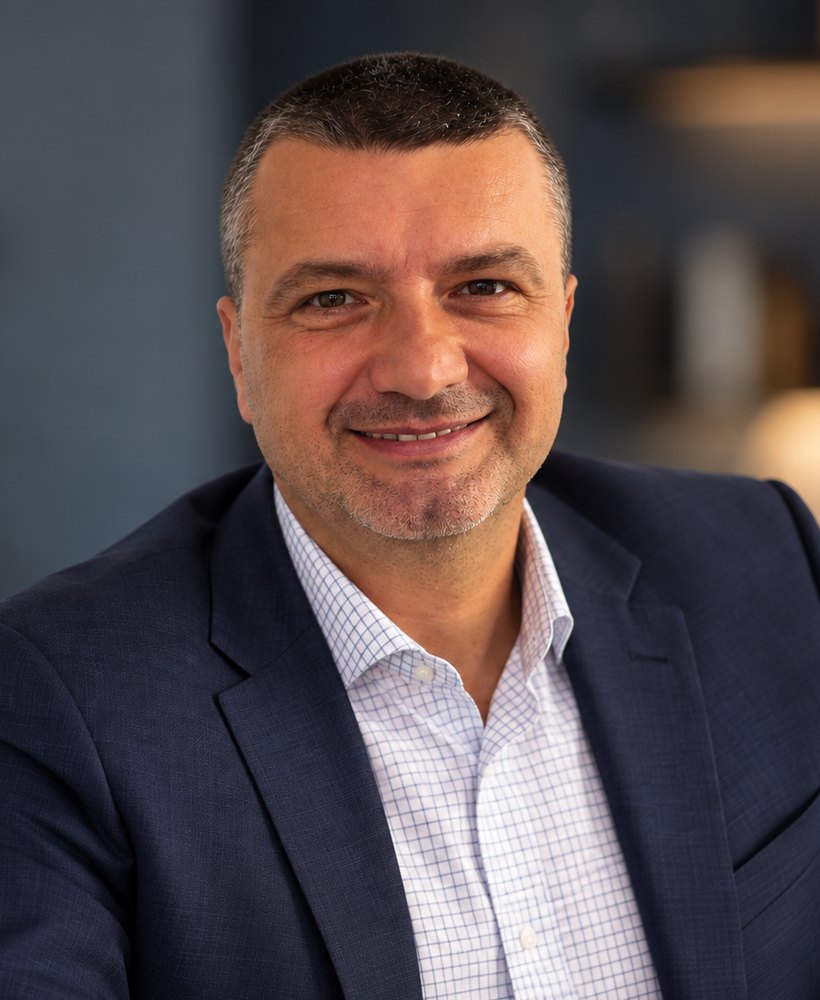
Interim CFO · Central Europe

Your accounts tell you what happened. I help you decide what happens next.

Most companies don't have an accounting problem. They have a problem with numbers that arrive late, don't match what is actually happening on the floor, and that nobody can read a next step out of. So: order in the numbers first — and then decisions that can rest on them. Neither one requires a full-time CFO.

The first call is free and carries no obligation. If I can't help you, I'll say so on the call.

25+ yearsas CFO, CEO and in interim roles
SK · CZ · PL · DACHSlovakia and Czechia as home markets
Manufacturing · services · retailtrade, e-commerce, property, automotive

How I think about it

Every number has a life

It came from somewhere. It travelled through something. It means something. Something will happen to it. And it will bring something back.

First

It began

Where and how it was created — and whether what got measured was what we meant to measure.

Second

It travelled

How many hands and systems it passed through before it reached the report. And what fell out on the way.

Third

It means

What follows from it when someone looks at it from outside, without the habit of seeing it.

Fourth

It's heading

Where it goes if nothing changes — and when that starts to hurt.

Fifth

It brings

What has to be done today so that in a year it brings back more. That's the whole point.

Accounting covers the first two stages. Reporting covers the third. My work is the last two — and there's no way to reach them without the first three.

When it's worth getting in touch

These are the sentences worth calling me about

If you recognise your own company in any of them, it can be fixed. In most cases it isn't bad management — it's a missing view.

“We're posting a profit, but there's no cash in the account.”

“I can't tell you which jobs made money and which didn't.”

“I don't get the monthly close until halfway through the following month.”

“Margins in our industry are just like that.”

“We have an ERP, but we still build the reports in Excel.”

“We're growing, and yet every month is tighter than the last.”

“My finance manager left and I have nobody to replace them.”

“I'm about to make an investment and I need someone to walk through it with me.”

“I'm at work fourteen hours a day and the company isn't moving.”

“Nothing moves without a decision from me.”

“We wrote the strategy at a workshop. Nothing has changed since.”

“We know what we want to achieve. I don't know what anyone should do tomorrow.”

The most common case: the company has outgrown its owner

Fourteen hours a day at work and the result doesn't move. It isn't about effort — in these companies effort is usually well above average. It's that there is no system in the business that decides in the owner's place. Authority was never delegated, responsibilities have no names attached, and so every question has to stop at the same desk.

A company in that state grows for exactly as long as one person can keep up. And the first step out of it is not hiring more people — without a system that only adds more things for you to approve. The first step is naming which decisions can be made without you, and which number tells you they were made well.

I work on this both in the diagnostic and in longer engagements — in practice it's the most common reason owners call me.

Services

Five ways I can take this on

Prices are indicative and depend on the size of the company and the scope of work. I'll give you the exact figure after our first conversation — up front, not after the hours are counted. I am not VAT-registered, so the amounts shown are final.

Recommended start

Diagnostic

An outside look at the business — at the numbers, and at how they come about and who is answerable for them. The output isn't a deck telling you what you already know. It's a list of the specific places where the company loses money or time, ordered by what's worth fixing first — and a proposal for how to fix it.

How it runs: an opening day at your premises — four to six hours of conversations with the owner and key people. Then you send me the underlying data. Within fourteen days of receiving it you have a written report with proposed solutions on your desk, which we then go through together in person.

I can usually see the critical bottlenecks and the places where things break after the first day or two. But at that stage it's a hypothesis, not a finding — and the difference between the two is the entire rest of the diagnostic. Those two weeks exist so I can test it against the numbers. What you get is evidence, not my impression.

  • Cash-flow: where money is tied up and for how long
  • Profitability by job, product or cost centre
  • Quality and speed of reporting — what you know and when you find out
  • Decision rights — what currently cannot be decided without the owner
  • People — who is actually driving growth, and who lacks authority or capacity
  • The seams where responsibility breaks between departments
from €1,900 one-off, fixed price Opening day on site, report within 14 days of receiving your data. If we then agree on a longer engagement, I deduct the diagnostic fee from the first invoice.

Interim CFO — and, where needed, CEO or COO

Financial leadership on a part-time basis — one to five days a month, or more intensively through a transition. I take responsibility for the number, not for a presentation about it. Typically when a company doesn't yet have the volume for a full-time CFO, but the owner can no longer run finance alongside everything else.

If the empty seat is above or beside that one — managing director, operations director — I can take that too. The role changes, the method doesn't: I start at the numbers and end at who is answerable for them.

  • Monthly close, management accounts and commentary for the board
  • Cash-flow planning and working capital management
  • Budget, forecasts and variance analysis
  • Negotiations with banks, investors and auditors
  • Taking over operational or statutory leadership through a transition
from €2,500 per month for an agreed scope Base scope 4 days per month. Minimum commitment 3 months, one month's notice. For irregular or short-term work, from €690 per day.

Cash-flow, reporting and controlling

A project with an end date: by the time it closes, the company can say on the same day every month how much it earned, on what, and what the next quarter looks like. I set it up so it keeps working without me in the room — including who carries which number.

  • A management report that can be read in ten minutes
  • A thirteen-week cash-flow plan and a routine for keeping it current
  • Costing, margins and a breakdown by cost centre or job
  • KPIs attached to named people, not to departments
  • Decision rights: who can approve what without the owner, and up to what amount
  • Training the people who will run it afterwards
from €4,500 per project Six to twelve weeks depending on company size and the state of the data. Price is fixed and agreed in advance.

Strategy and group management

Strategies rarely fail because they were wrong. They fail because no number and no name ever got attached to them — and a year later there's another workshop. My job is to translate intent into steps that someone owns, with a deadline and with a number that shows whether it's working.

In groups of companies there's an additional layer that isn't visible from outside: where goods move between entities, who funds whom, and what that does to margin and to tax. Optimising those flows is usually the cheapest source of money a group has.

  • Translating strategy into steps — commercial, product and financial
  • The numbers that show progress along the way, not only at year end
  • Group management: goods flows, intra-group funding and transfers
  • Entering a new market or segment — from first thought to first budget
  • Staying through execution, rather than handing over a document
from €9,500 per project For a long-term mandate at group level, from €950 per day. Market entry is quoted separately according to scope.

ERP, processes and data

I sit on both sides of the table: I know what financial management needs from a system, and what can realistically be implemented. Most failed ERP projects don't break on the software — they break because nobody said in advance which number was supposed to come out at the end.

  • Requirements and vendor selection, including running the tender
  • Process and data design before implementation begins
  • Project oversight on the client side
  • Rescuing implementations that have stalled mid-flight
  • Management dashboards on top of the data you already have
  • Assessing which of a vendor's “artificial intelligence” is a real feature and which is a slide
from €690 per day · or a fixed project price For implementation oversight, typically 2–4 days a month for the duration of the project.

Cases

Three cases that show how I work

I don't name clients without their consent. Figures are in percentages rather than absolute amounts, for the same reason.

Retail chain

Five stores moved to 24/7 operation

Stores outside the large cities, unstaffed after normal closing hours. The question on the table wasn't technical but financial: whether the extra hours would pay for themselves.

The interesting part was where the revenue actually came from. Not at night, as everyone expected — on Sundays and public holidays. Without measuring after the rollout, nobody would have found that, and the project would have been judged against the wrong hypothesis.

I was there for finance and co-signed the decision with the CEO and COO. I did not run the project.

+10 – 30% revenue of the stores concerned +10 – 40% EBITDA over the year

Electrical installation · ongoing mandate

Eighteen field teams and no financial plan

Around three hundred installations a month, six depots, three warehouses — and the whole thing run out of spreadsheets. When I arrived the company had neither a financial plan nor a cash-flow plan. It wasn't that the arithmetic was wrong. There was nothing to decide against.

I'm putting governance, processes, controlling and cash-flow planning in place. In parallel I'm developing the in-house software that holds the operation together.

What was done when: within four weeks, a financial plan, an outline cash-flow plan, basic controlling and management reporting. Within eight weeks, a proposal for changes to governance, KPIs and the incentive system.

Interim role, engagement ongoing. Details subject to the client's agreement.

4 weeks financial plan, cash-flow, controlling and reporting 8 weeks governance, KPI and incentive proposal

My own experiment

A week of measuring, a week of change, a fifth more revenue

To test how quickly I can find my way around an operation I know nothing about, I went into one: I drove a taxi through a ride-hailing app. In the first week I changed nothing and only measured, so that I'd have a baseline. In the second I changed how I worked.

The twenty percent isn't the point. The point is that without the first week I wouldn't have known whether anything had changed at all — and that is exactly what happens in companies with most decisions that present themselves as evidence-based.

My own data, my own time. I write about it on LinkedIn.

+20% revenue in week two against the measured baseline

Results cannot be promised and I don't promise them. These figures come from particular companies in particular circumstances and are not a forecast of what will happen in yours.

How it works

Four steps, no surprises on the invoice

A call, thirty minutes

Free and without obligation. I want to know what brought you here and what you've already tried. If your situation is outside what I can help with, I'll say so on that call and point you to someone else.

A proposal with a fixed price

Within five working days you get a one-page proposal: what I'll do, by when, what I need from you and what it will cost. The price is fixed — hours don't get added on afterwards.

The work, in your business

Part on site, part remote. You always know what I'm working on and what's finished. I talk to the people who will use it, not only to the management team.

A handover that survives my departure

Every output has a named owner inside your company and a written procedure. The goal is not for you to need me. The goal is for you to be able to decide without me.

About

Vladimír Čajka

For more than twenty-five years I've worked between finance and operations — in roles where preparing the report wasn't enough, because a decision had to follow from it. I've worked in manufacturing, trade, services and property management, and in each of those sectors I led the implementation or rebuild of an information system. I've also founded my own company, so I know what that decision looks like from the other side of the table. And at I.D.C. Holding I was the CFO responsible for launching a foreign market from zero — a discipline in which you can't fall back on “this is how we've always done it”.

One habit stayed with me from all of that, and it's the one clients find most useful: I don't trust a number until I know how it came about. Most of the problems I find in companies aren't that someone calculated badly. They're that what gets measured is not what gets managed — and that nobody owns the end result in full.

That instinct isn't an accident; it comes from my education. I started in economic cybernetics and business informatics, and business management came afterwards. That's why what interests me in a company isn't only what number came out, but the route the data took to get there — and where it broke along the way.

I don't sell methodologies or ready-made templates. I do what will make the biggest difference first in this particular company — and I say it even when it isn't what you want to hear.

I write regularly about how I think about this on LinkedIn — including the taxi experiment above. If you came here from there, you know what you're getting.

Selected experience

  • Industry and engineering — a single ERP across the companies of a group, 75 users
  • Property management — 60 buildings under management, request handling 50% faster
  • Insurance and loss adjusting — 34% increase in disputed cases identified
  • I.D.C. Holding — as CFO, responsible for a foreign market launch, entirely from zero
  • Trade, e-commerce and services — costing, margins and management reporting
  • Automotive — sales, service and financing joined into a single flow
  • Languages — Slovak, Czech, English, German, Polish, Russian

Education

  • Ing. (MSc), Business Management
    University of Economics in Bratislava
  • Bc. (BSc), Business Informatics
    University of Economics in Bratislava
  • Economic Cybernetics
    Dnepropetrovsk State University, Faculty of Economics (today Dnipro, Ukraine)
  • General Management Course
    a one-year programme taught by University of Groningen faculty in Bratislava
  • Machine learning and neural networks
    six-month certified course

What you won't get from me

So neither of us wastes the first call finding out.

Frequently asked

Before you get in touch

What size of company is this for?

The lower bound is roughly €2 million in revenue — the point at which one person can no longer see the whole company at once. For smaller companies, the diagnostic alone usually delivers most of the value.

There's no upper limit. With groups the work simply moves elsewhere: from a single set of accounts to the flows between entities, intra-group funding and transfer pricing.

How is this different from an accountant or a tax adviser?

An accountant records the past, and does it correctly. A tax adviser handles how the past is settled with the state. I work with what the numbers imply for future decisions — and with whether they measure what you actually manage. Three different roles; they don't compete.

Delegation and decision rights sound like organisational consulting. Why a CFO?

Because you can only delegate what can be checked without you. Until there's a number that tells you whether the person did it well, you aren't delegating responsibility — only work that you still have to review. That's why this starts at the numbers and ends at the organisation, not the other way round.

How much time will this take from me and my people?

For the diagnostic it's one shared day — four to six hours of conversations with you and your key people — plus the time to pull the data together. The rest is on me. In a longer engagement it's less still: after the first month I can carry most of it.

Where do you work, and in which languages?

My centre of gravity is Slovakia and Czechia — I'm currently on a mandate in the Czech Republic. Poland and the German-speaking markets by arrangement; I cover them linguistically. I work in Slovak, Czech, English, Polish and German.

Reporting, documentation and board materials can be delivered in English throughout. Most of the work can be done remotely; the first call and key meetings I prefer in person.

Do you actually have capacity?

At the moment two to three days a week are taken by one long-term mandate. The rest is open, which in practice means room for one diagnostic and one longer engagement at a time. If capacity isn't there, I'll tell you on the first call rather than keeping you in a queue.

How do you handle confidentiality?

I sign an NDA as a matter of course, before I see the first number. I never publish client names without their consent.

Our data is a mess. Is there any point starting?

There is, and it's the more common starting point of the two. A diagnostic can be done over disorganised data — the state of the data is itself one of the findings. Waiting until things are tidy means, in most companies, never starting.

Let's start with a conversation, not a proposal

Thirty minutes, free and without obligation. Pick a time that suits you — or write me two sentences about what troubles you most in your numbers.

or

I reply within one working day. Your details are used only to answer your message — see the privacy notice.